When I look back, I don’t know how I managed my first 5 years of teaching without it. These days, I cant get enough of it.
My visualiser has become one of my most effective teaching tools. I use it so much more than before and for so many different reasons.
I have found that the visualiser helps with HAPs and boys- Yes, two of our target groups.
So, I hear you ask, what am I doing with the visualiser? Well, nothing extraordinary.
In terms of the boys, I use it as a stimulus for them to engage with long answer questions. Before a task I will let the class know that I will be selecting a student from my random name generator to share their work under the visualiser. Whether they want to impress or not look daft in front of others, it seems to work in getting them to write.
When it comes to the HAPs, I like to use my visualiser to dissect answers with them. The other day, I timed myself over break to write an answer to an exam question and shared it under the visualiser. The students loved the fact I had written it and were keen to see what I did well and how it could have been improved. By doing this it challenged the students to do better.
In geography we sometimes draw diagrams (not colour in) and graphs. The visualiser is a great tool to model step by step what I would like students to do.
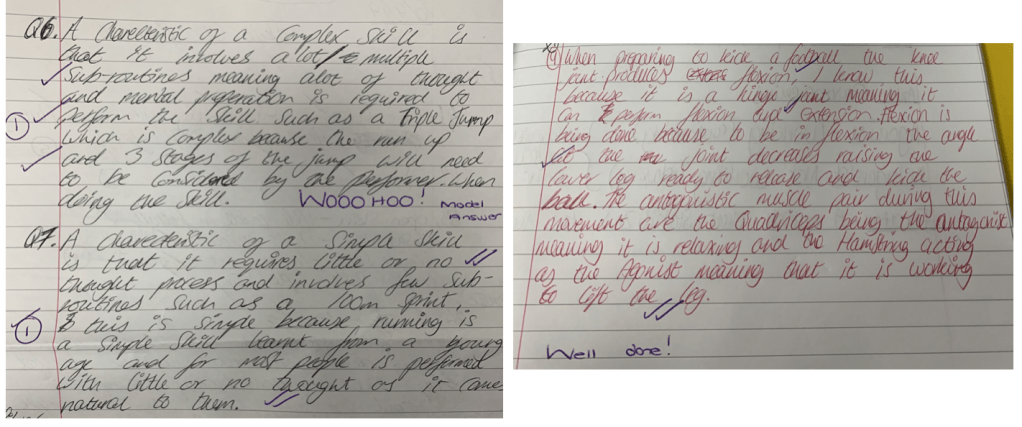
More recently, as a department, we have tried to move away from mass marking and providing other valuable feedback. Using a visualiser is a great way to do some whole class live marking; it involves all students, it becomes a whole class ‘peer’ assessment activity. Students then use that feedback to improve their own answers.
I could go on. But to summarise, if you have a visualiser gathering dust, give it another try and if you have not used one before, see how it goes.
There have been many changes to education for children with special educational needs and disabilities (SEND) in the last few years. The 2014 ‘The Children and Families Act’ brought a clear expectation that most pupils with SEND would be taught in a mainstream school, and that every teacher is a teacher of SEND. As you will all know, in a class of 32, there are numerous different personalities, different special educational needs, different issues that have arisen that day and different emotional needs, making it very difficult to plan amazing lessons. But how can we ensure we are successfully supporting each and every SEND student that sits in front of us every single day?
The SEND principles are designed to ensure we do exactly this. They are designed for teachers and classroom learning assistants to work together to ensure each and every SEND student succeeds. Research shows SEND students need just as much teacher time as non-SEND students; with extra input from CLAs. As we know, if we are Challenging, Explaining, Modelling, Questioning, giving Feedback, ensuring students are Practicing and making time for the students to Retrieve the information learnt, then all students will achieve. And this is no different for SEND students. The way in which we plan these may be slightly different, but the principles of learning are not. For instance, when modelling with SEND students who you know struggle with retrieval, we may use the I,I,I,We,We,We,We,We,You, approach, whereas with a class you know don’t struggle so much to retrieve information, it may be a simple I,I,We.We,You approach to result in successful retrieval, or even in a perfect classroom an I,We,You approach, but we all know they don’t exist! For SEND students though, it is vitally important that after this guided practice phase, students are given time to do some independent practice so we can ensure SEND students are gradually (but certainly) being released into independent practice without errors or misconceptions.
Another of the principles that is vitally important to the achievement of SEND is Challenge. Gone are the days when SEND students were in another room with the SENCO, they are now in front of you all every day. Gone are the days of questions such as ‘How can I dumb it down?’ floating around teachers’ heads as they planned for SEND students. Now we ask ‘What do I need to plan in order for each and every student to reach that objective?’ Chunking is something I have seen used in so many different, yet so many successful ways across school. Whether it be teachers using the CLAs to work with a certain group in the class for the lesson, or CLAs physically cutting up worksheets so students aren’t daunted by the task, or teachers modelling a small part of a ‘Boy In the Striped Pyjamas’ analysis paragraph, ensuring understanding on that, before modeling the rest – I know as a school we are challenging all SEND students all of the time, so thank you very much!
Download Meden’s SEND Learning Principles by CLICKING HERE
Since the new GCSE PE specification was released with a greater emphasis on the theory of PE rather than practical ability, I have struggled to balance teaching the new subject content alongside providing enough time for students to apply their knowledge and understanding by practicing more exam questions. As a result of this, I found myself thinking about how more practice could be incorporated into each lesson without it being at detriment to the learning that needs to take place.
Across the two years, I have tried a range of ideas from setting exam questions as homework, to the ‘mix it up’ method of asking students to start the lesson with an exam question. Although useful, I often found that I was not dedicating enough time in the lesson for this and progress would be superficial and just in the lesson rather than retention over time.
This year, I decided that giving students more time to practice, embed their learning and retain knowledge in their memory was something that the PE department would focus on and something I would trial in my Year 11 GCSE PE class.
Having three single lessons with the group this year has enabled me to experiment with how I deliver and revisit the content for the theory exams alongside ensuring they have more time to practice the exam questions.
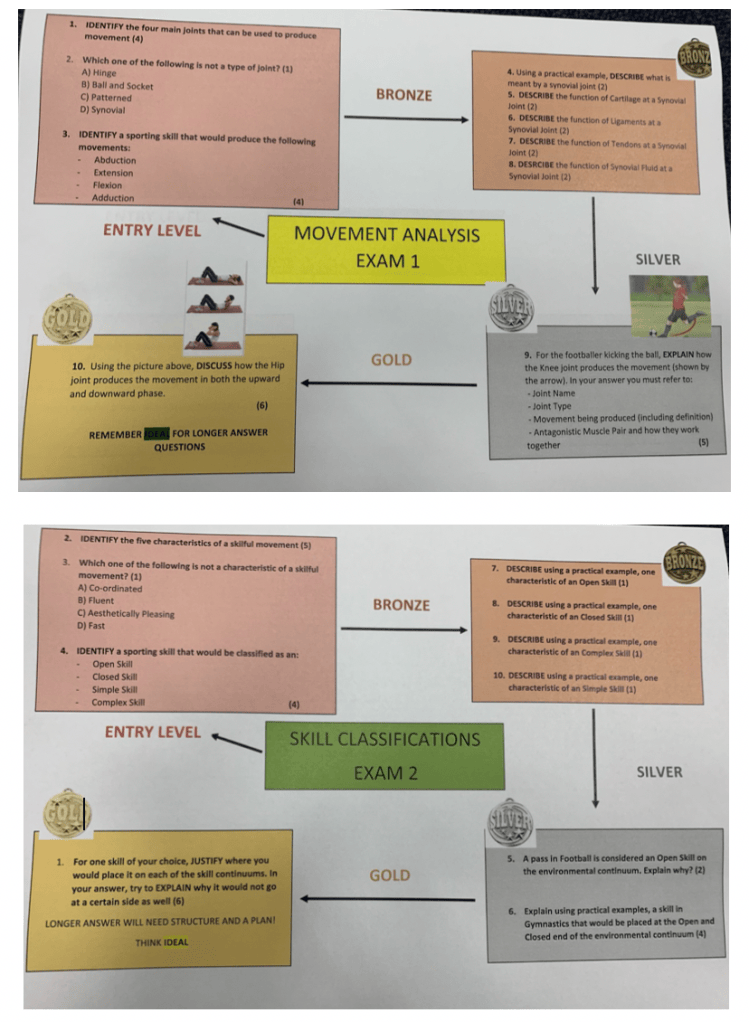
I decided that I would do one lesson for exam one and one lesson for exam two, each week, where I would teach all of the content again and allow students time to reflect on what they have learnt previously and address any misconceptions. I would then do an ‘Exam Prep’ lesson per week which would enable me to combine the practice methods of ‘Fold it in’ (linking one topic to another) and ‘Withhold Scaffolding’ (a series of questions based on content that has already been covered and is being revisited).
Within the ‘Exam Prep’ lesson students complete a range of past paper exam questions based on the knowledge they have covered in the two lessons that week. The questions are structured using the exam command words so that the depth of answer required for each question gradually gets harder. All of the questions are realistic of what they will get in the real exam and enable students dedicated time to apply their knowledge in a realistic way. All students start at the entry level and then work their way through each of the levels within the allocated time.
In order to create a subject specific learning habit for the students and allow them to practice effectively, I decided that ‘Focused Independent Time’ would be used for students to complete the exam questions. This way they should start to learn that the structure and expectations of the lesson would not change from one week to the next and that over time their exam technique for GCSE PE should improve.
Example of the question sheets used during the ‘Exam Prep’ lesson
But Miss……when are we doing practical?
Due to the new specification placing a greater emphasis on the theory of PE rather than practical ability, I have also faced another challenge with embedding practice which I knew I would need to address in the ‘Exam Prep’ lesson this year. This challenge centres around boys’ motivation towards theory lessons and ultimately their underachievement in the exams due to a fixed mindset.
Every week, regardless of how many times I explain it, the boys in the group will ask why they are doing theory again and not practical. There seems to be a perception amongst the boys that their practical ability will boost their grade alone without the need to do well in the theory exams.
When doing a practical lesson, the boys will happily practice a skill over and over again without complaining until they are successful, yet when asked to practice their theory knowledge through exam questions they will demonstrate avoidance behaviour and look for the easy way out. This behaviour can be defined as a reluctance to learn or complete work that may challenge them in fear of failing in front of their peers. Instead, boys will only attempt work or challenges that they know they are capable of doing and will result in success; like their practical ability.
With this in mind, I needed to find a way of engaging the boys in my ‘Exam Prep’ lesson so that they were more motivated to practice their learning. I decided that I would introduce a ‘Contender/Coach’ system whereby students were allowed to pick another student in the class that they would compete against and support throughout the year.
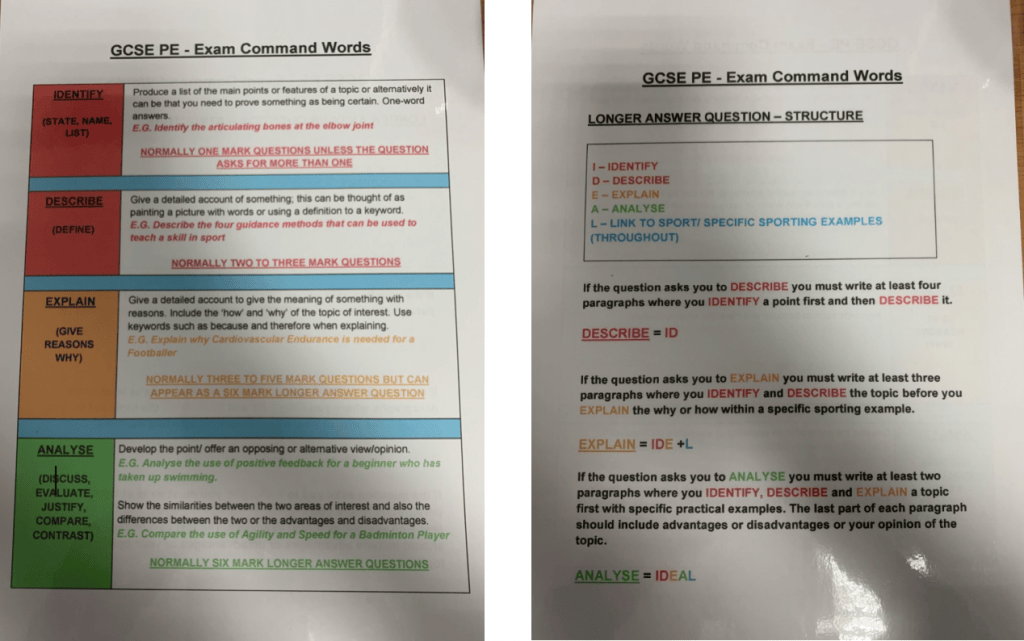
In the lesson, students complete as many of the questions as they can in the allocated FIT time. They are provided with the Knowledge Organisers from the two lessons in the week, a GCSE PE textbook, exam command word help sheet and their own books to use if they are unsure of an answer. After 30 minutes, students swap their work with their contender/coach and use the same resources to check their answers and mark them.
The exam command word help sheet used in lessons
Feedback is given to their contender/coach and then they take their book home to respond to the feedback and make any necessary amendments. They also use the time at home to complete any questions that they did not finish.
Within the lesson, I facilitate during the FIT time and provide help and support when all other avenues have been exhausted. I then mark their books and give them a mark and a grade based on the grade boundaries for each exam which they get in their lesson the following week.
I was expecting to experience some resistance to this, especially with the boys, so I gave myself six weeks to have it embedded and working. However, I was surprised after the first lesson to see all of the boys fully engaged because of the competitive element. It is still very much a work in progress, but I have seen quite a lot of impact for both the students and my teaching in a short period of time. This week I have created a question sheet that links all of the topics we have covered so far together so that students are given an opportunity to continually practice and revisit their knowledge.
Impact on Boys’ Motivation and Progress
All students are engaged and wanting to practice. This has led to motivation improving dramatically
Behaviour management is good as students are in a regular routine and know what is expected of them
Students are happy to make mistakes as they know they are practicing
Students are engaging with feedback, so they can improve their answers
Knowledge of exam technique and exam command words is improving as students know and can demonstrate the depth required for each question
Students are repeating the same content through different exam questions, so retention and knowledge organiser test scores are improving
Students are enjoying the experience of success whereby it motivates them to try harder in the next lesson
Independence is improving as they will use the tools and resources provided before asking me
A growth mind-set is developing where students are not giving up
Literacy is improving as students are using subject specific terminology
Knowledge organiser are an integral part of the exam prep lesson whereby students are learning how to use them to practice and revise
All students are producing work that is on or above their target grade and they are all making progress
Impact on my Teaching
Marking is quicker and it is easier for me to spot misconceptions and address them instantly in the next lesson
Tracking grades after each set of questions allows me to see where students are understanding the content and where topics need to be revisited
Intervention is personalised so that students can practice the topics they need to work on
I’m usually a fan of words but
these six have lodged themselves firmly in my Top 10 Dreaded Monosyllabic Word
Bank Of All Time: “I don’t know how to start’ …
We’ve all been there, haven’t we?
32 nodding heads signifying that yes, that makes sense Miss, and Yes Sir, I get
it, but 10 minutes into independent practice time, you spot those students who
have taken the springs out of their pens rather than using them in a way Bic
intended.
And from this, stemmed PEE and
PEA and PEEL and PEELE and PELE ….acronyms followed (usually) by words or sentence
stems. Whilst topic sentences and scaffolds can be (and are!) a very effective
strategy to support students with writing for example, I realised quickly that
these structures were constraining and often stifled students’ responses. More
worryingly, students often equated a particular ‘step’ or sentence stem with a
grade and wrongly assumed that writing a PEE, or PEA or PEEL meant that they
produced Grade 9 work. HAPS in particular were often limited and restricted
from developing their points to produce original, creative and evaluative
responses. By constantly providing students with these scaffolds, teachers
nationwide metaphorically spoon fed their students, and in the words of EM
Forster, ‘spoon feeding in the long run teaches us nothing but the shape of a
spoon.”
It was time to use a knife and
fork again.
For me, that process was to move
beyond modelling ( showing what to do through static teacher examples) to live
modelling (showing how to do it by articulating ideas and thought processes).
This can be difficult and requires a great deal of confidence in your subject
knowledge, but it is the most efficient
and effective way of ensuring students know what
is expected of them, how they
secure what is expected of them and why
the steps to securing what is expected of them are important.
It is impossible to teach a
lesson in English without modelling and vocabulary instruction plays a huge
part in this, but for now I will focus on ways we use visualisers. Here are
some of the ways live modelling has become an active process that combines
teacher explanations (I do), targeted questions (we do) and independent
practice (you do):
Modelling reading strategies:
Approaching an unseen text can be
daunting and students can find it a challenge to know what to ‘look’ for.
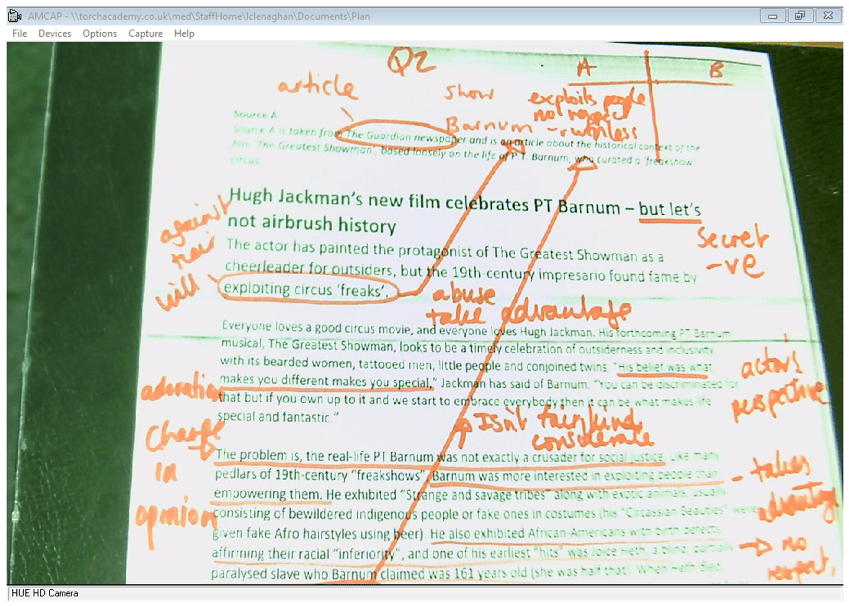
Modelling that process first allows the teacher to talk through each paragraph
and plan for particular questions. Q&A is essential to verbalise your
thought process:
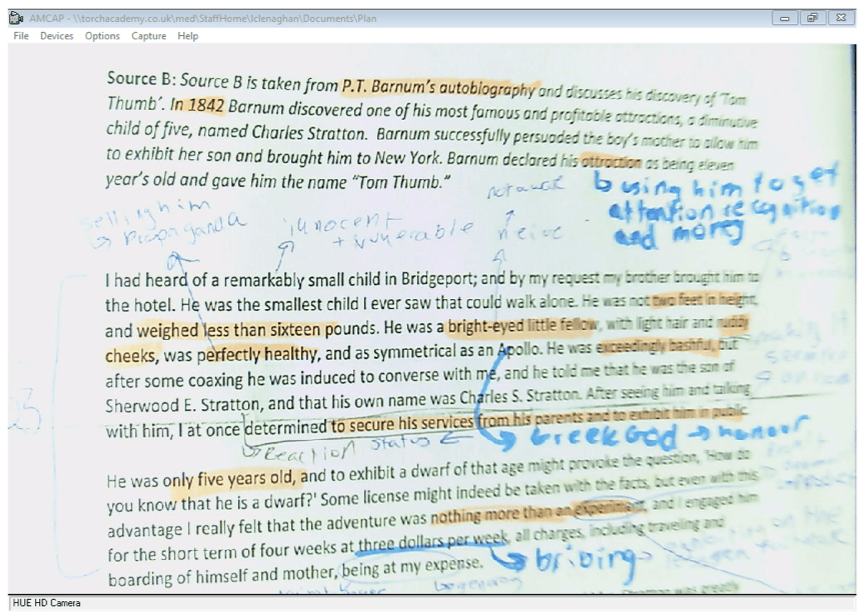
From this, I then present a more challenging extract to students to actively read a text independently, in this case a 19th century autobiography, using the same thought processes:
Developing and deconstructing exemplar materials:
Involving all students is the
best way to deconstruct an exemplar piece as this can then support them in
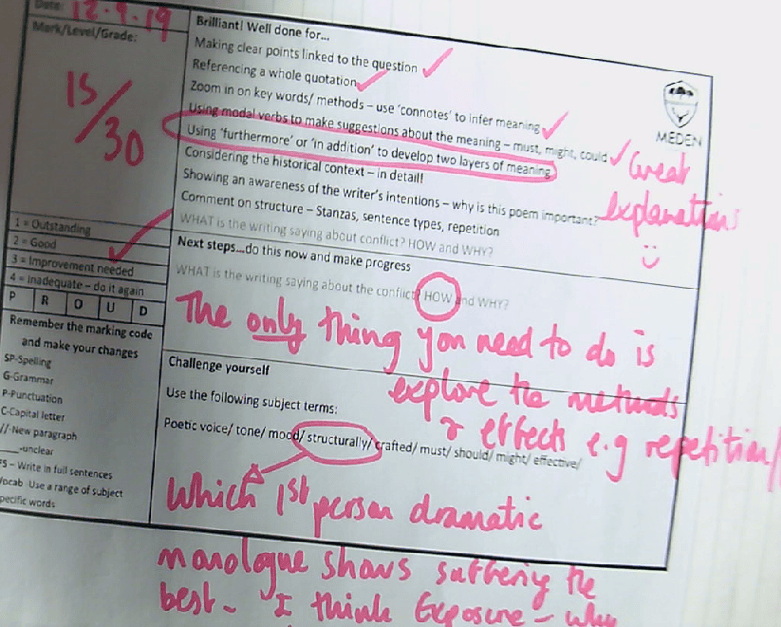
developing their own responses. I demonstrated marking this piece of work to
Q&A a range of students in evaluating it:
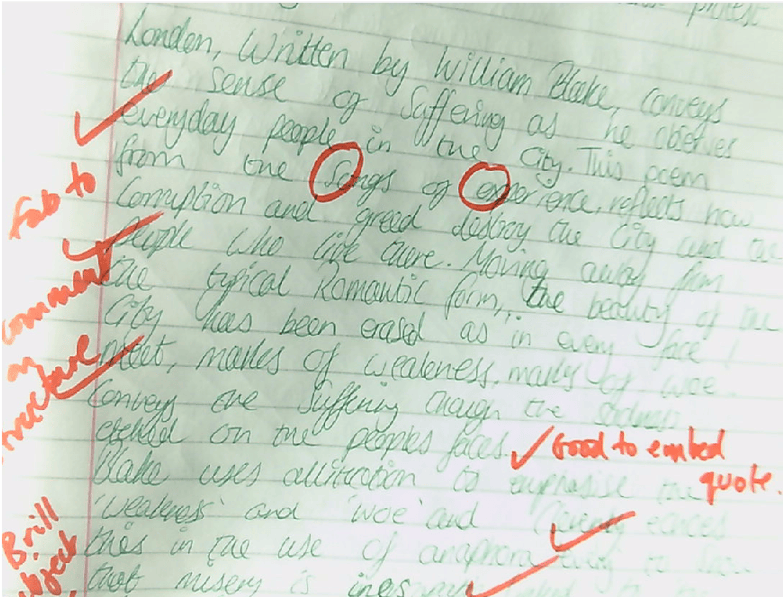
The
outcome enabled the most vulnerable students to access the stretch and
challenge:
Acronyms, scaffolds and sentence
stems are beneficial, but the aim is to gradually remove these and increase the
level of difficulty necessary for the learning process. Live modelling applies
to non-written based learning too: demos, practicals, drama, S&L. If you do
not increase the level of challenge over time though, you will not be
effectively modelling.
Effective modelling makes you a
better teacher and better teaching leads to better outcomes. You may feel that
students are blindly copying you but with a skilful manipulation of
questioning, explaining, demonstrating and clarifying, you are enabling your
students to engage with you and succeed. Effective modelling also saves you
time because you can address misconceptions before they even arise. Which leads
me to the remaining 4 words in my Top 10 Dreaded Monosyllabic Word Bank Of All
Time: I don’t get it.
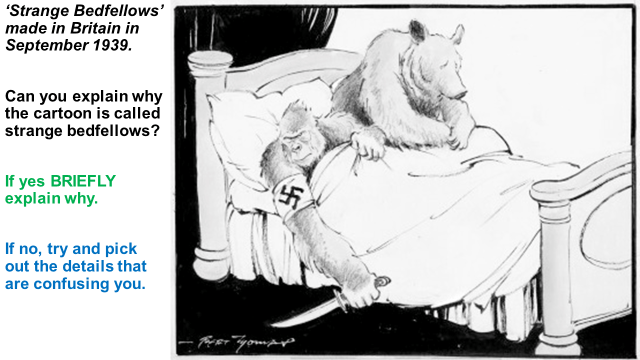
An issue that often crops up in history lessons is a student’s reluctance to answer questions, whether that is because they are unsure of the demands of the question or because of the subjective nature of the answers that can be given. An effective way of working around the aforementioned problem is to ask the students what they are unsure of. This eliminates the students’ avenues to being passive (I don’t know!!), and really makes them think about what is stopping their learning. An example of is approach is attached below. This slide was used towards the beginning of the lesson; students already had some prior knowledge of the topic but hadn’t seen it represented in cartoon form.
The title of the cartoon was used within the question in
order to develop understanding of prior knowledge students had gained in
previous lessons. It was predicted that some students may not be able to make
the link between the prior knowledge they had attained and the imagery in the
cartoon. Therefore, students that could not explain the title of the cartoon
were asked to pick out the details that were confusing them so that other
students could aid their understanding in the class discussion that followed.
When students were asked to reveal their answers on their
whiteboards, one pair had picked out details from the source that they were
confused by. The classroom discussion started by asking them what they didn’t
understand and opening this up to the rest of the class. The rest of the class
were able to facilitate the learning of this pair by providing explanations
about the details from the source that they were unsure of. This consequently
allowed the pair who were confused by the question and the cartoon to
participate fully in the subsequent debate around the question and gain further
understanding of the topic being taught.
Further into the lesson, another cartoon related to the
topic being taught was introduced alongside an exam style question. All
students felt confident in answering the question due to the previous
discussion around the cartoon and topic at the start of the lesson.
Every fortnight a member of staff will taken over the T&L blog and blog about how they are developing the learning principles in the teaching or discussing educational research/books/articles they have read. There will be a link to each blog post in the T&L fortnightly email sent out to staff.