
Blog Post by Lisa Clenaghan
I’m usually a fan of words but these six have lodged themselves firmly in my Top 10 Dreaded Monosyllabic Word Bank Of All Time: “I don’t know how to start’ …
We’ve all been there, haven’t we? 32 nodding heads signifying that yes, that makes sense Miss, and Yes Sir, I get it, but 10 minutes into independent practice time, you spot those students who have taken the springs out of their pens rather than using them in a way Bic intended.
And from this, stemmed PEE and PEA and PEEL and PEELE and PELE ….acronyms followed (usually) by words or sentence stems. Whilst topic sentences and scaffolds can be (and are!) a very effective strategy to support students with writing for example, I realised quickly that these structures were constraining and often stifled students’ responses. More worryingly, students often equated a particular ‘step’ or sentence stem with a grade and wrongly assumed that writing a PEE, or PEA or PEEL meant that they produced Grade 9 work. HAPS in particular were often limited and restricted from developing their points to produce original, creative and evaluative responses. By constantly providing students with these scaffolds, teachers nationwide metaphorically spoon fed their students, and in the words of EM Forster, ‘spoon feeding in the long run teaches us nothing but the shape of a spoon.”
It was time to use a knife and fork again.
For me, that process was to move beyond modelling ( showing what to do through static teacher examples) to live modelling (showing how to do it by articulating ideas and thought processes). This can be difficult and requires a great deal of confidence in your subject knowledge, but it is the most efficient and effective way of ensuring students know what is expected of them, how they secure what is expected of them and why the steps to securing what is expected of them are important.
It is impossible to teach a lesson in English without modelling and vocabulary instruction plays a huge part in this, but for now I will focus on ways we use visualisers. Here are some of the ways live modelling has become an active process that combines teacher explanations (I do), targeted questions (we do) and independent practice (you do):
Modelling reading strategies:
Approaching an unseen text can be daunting and students can find it a challenge to know what to ‘look’ for. Modelling that process first allows the teacher to talk through each paragraph and plan for particular questions. Q&A is essential to verbalise your thought process:
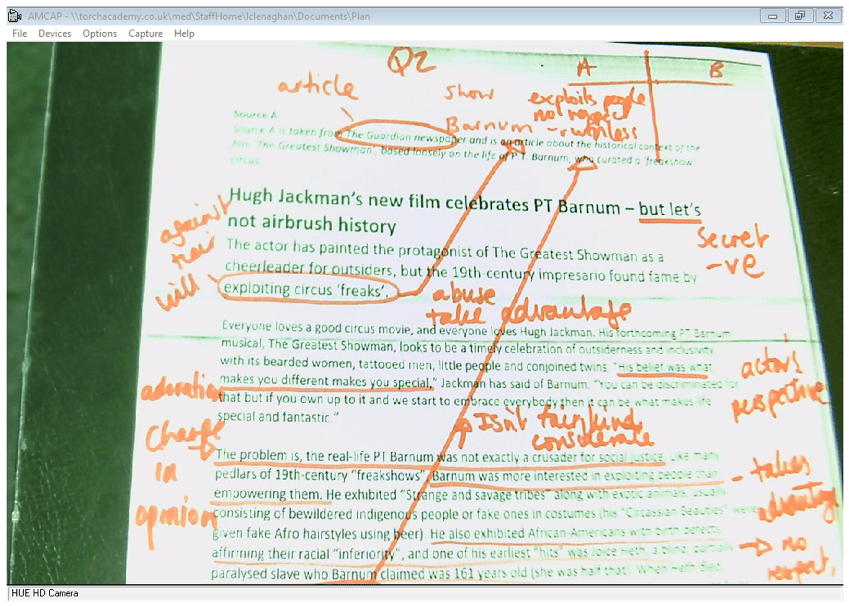
From this, I then present a more challenging extract to students to actively read a text independently, in this case a 19th century autobiography, using the same thought processes:
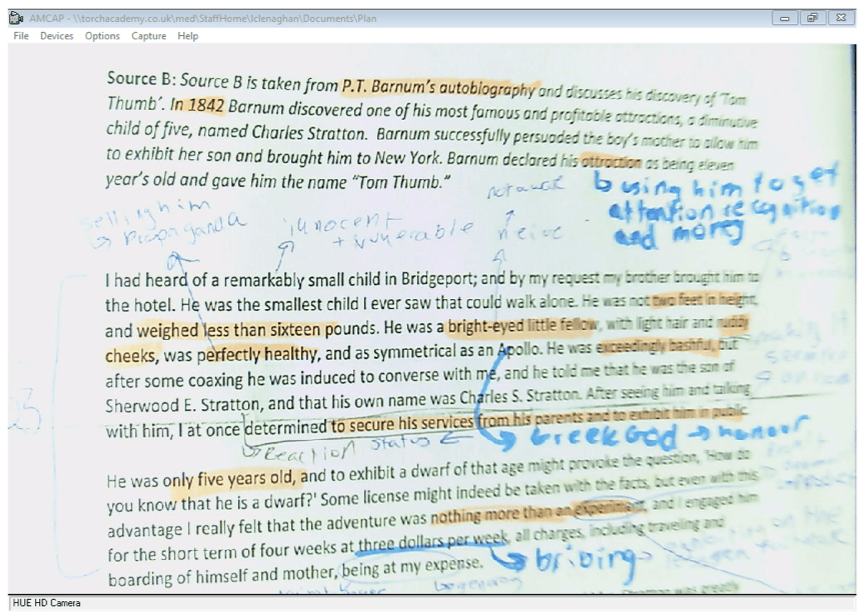
Developing and deconstructing exemplar materials:
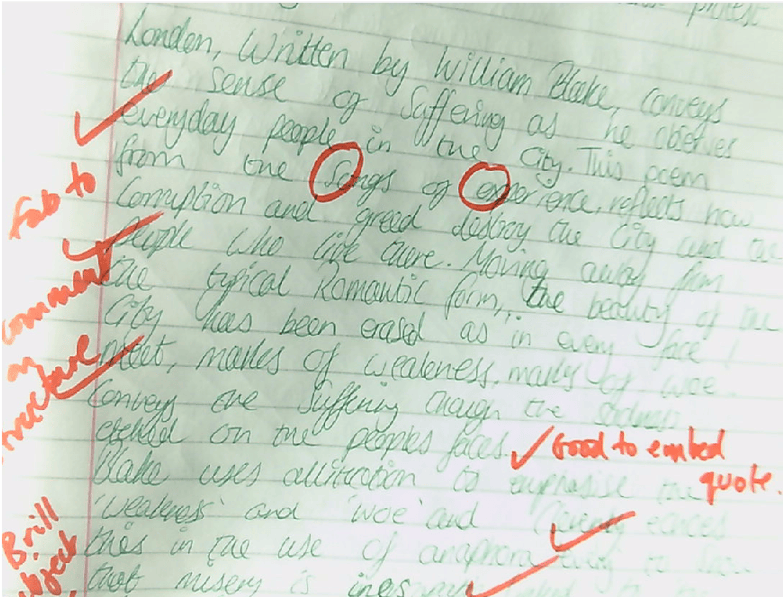
Involving all students is the best way to deconstruct an exemplar piece as this can then support them in developing their own responses. I demonstrated marking this piece of work to Q&A a range of students in evaluating it:
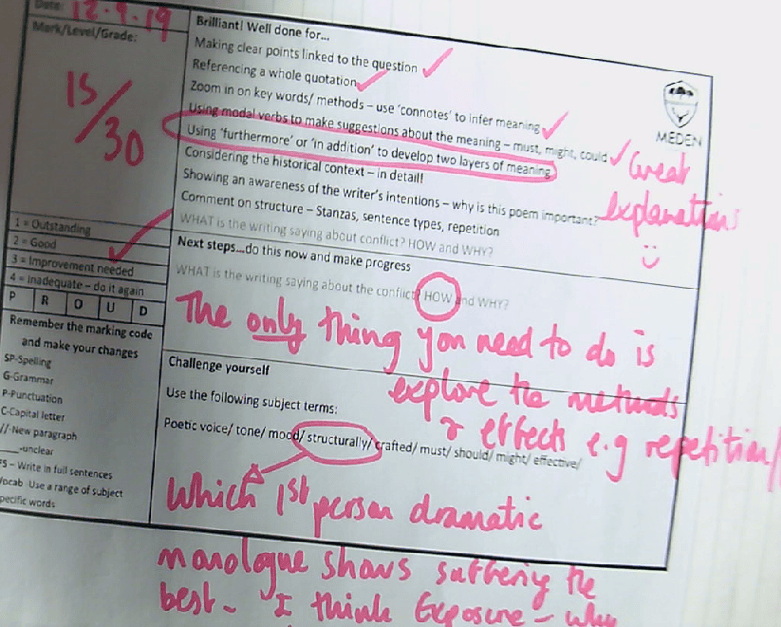
The outcome enabled the most vulnerable students to access the stretch and challenge:
Acronyms, scaffolds and sentence stems are beneficial, but the aim is to gradually remove these and increase the level of difficulty necessary for the learning process. Live modelling applies to non-written based learning too: demos, practicals, drama, S&L. If you do not increase the level of challenge over time though, you will not be effectively modelling.
Effective modelling makes you a better teacher and better teaching leads to better outcomes. You may feel that students are blindly copying you but with a skilful manipulation of questioning, explaining, demonstrating and clarifying, you are enabling your students to engage with you and succeed. Effective modelling also saves you time because you can address misconceptions before they even arise. Which leads me to the remaining 4 words in my Top 10 Dreaded Monosyllabic Word Bank Of All Time: I don’t get it.


