
Blog Post by Tom Bentley
An issue that often crops up in history lessons is a student’s reluctance to answer questions, whether that is because they are unsure of the demands of the question or because of the subjective nature of the answers that can be given. An effective way of working around the aforementioned problem is to ask the students what they are unsure of. This eliminates the students’ avenues to being passive (I don’t know!!), and really makes them think about what is stopping their learning. An example of is approach is attached below. This slide was used towards the beginning of the lesson; students already had some prior knowledge of the topic but hadn’t seen it represented in cartoon form.
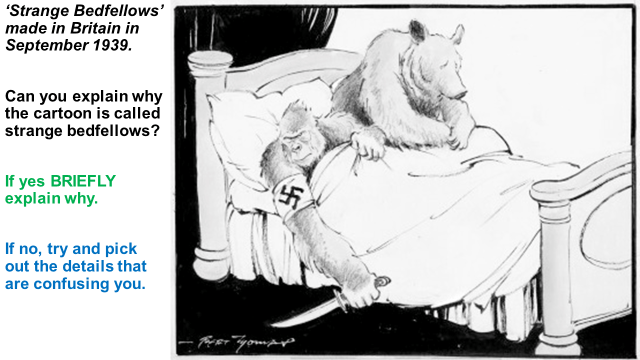
The title of the cartoon was used within the question in order to develop understanding of prior knowledge students had gained in previous lessons. It was predicted that some students may not be able to make the link between the prior knowledge they had attained and the imagery in the cartoon. Therefore, students that could not explain the title of the cartoon were asked to pick out the details that were confusing them so that other students could aid their understanding in the class discussion that followed.
When students were asked to reveal their answers on their whiteboards, one pair had picked out details from the source that they were confused by. The classroom discussion started by asking them what they didn’t understand and opening this up to the rest of the class. The rest of the class were able to facilitate the learning of this pair by providing explanations about the details from the source that they were unsure of. This consequently allowed the pair who were confused by the question and the cartoon to participate fully in the subsequent debate around the question and gain further understanding of the topic being taught.
Further into the lesson, another cartoon related to the topic being taught was introduced alongside an exam style question. All students felt confident in answering the question due to the previous discussion around the cartoon and topic at the start of the lesson.


