
Blog Post by Fiona Garlick
Since the new GCSE PE specification was released with a greater emphasis on the theory of PE rather than practical ability, I have struggled to balance teaching the new subject content alongside providing enough time for students to apply their knowledge and understanding by practicing more exam questions. As a result of this, I found myself thinking about how more practice could be incorporated into each lesson without it being at detriment to the learning that needs to take place.
Across the two years, I have tried a range of ideas from setting exam questions as homework, to the ‘mix it up’ method of asking students to start the lesson with an exam question. Although useful, I often found that I was not dedicating enough time in the lesson for this and progress would be superficial and just in the lesson rather than retention over time.
This year, I decided that giving students more time to practice, embed their learning and retain knowledge in their memory was something that the PE department would focus on and something I would trial in my Year 11 GCSE PE class.
Having three single lessons with the group this year has enabled me to experiment with how I deliver and revisit the content for the theory exams alongside ensuring they have more time to practice the exam questions.
I decided that I would do one lesson for exam one and one lesson for exam two, each week, where I would teach all of the content again and allow students time to reflect on what they have learnt previously and address any misconceptions. I would then do an ‘Exam Prep’ lesson per week which would enable me to combine the practice methods of ‘Fold it in’ (linking one topic to another) and ‘Withhold Scaffolding’ (a series of questions based on content that has already been covered and is being revisited).
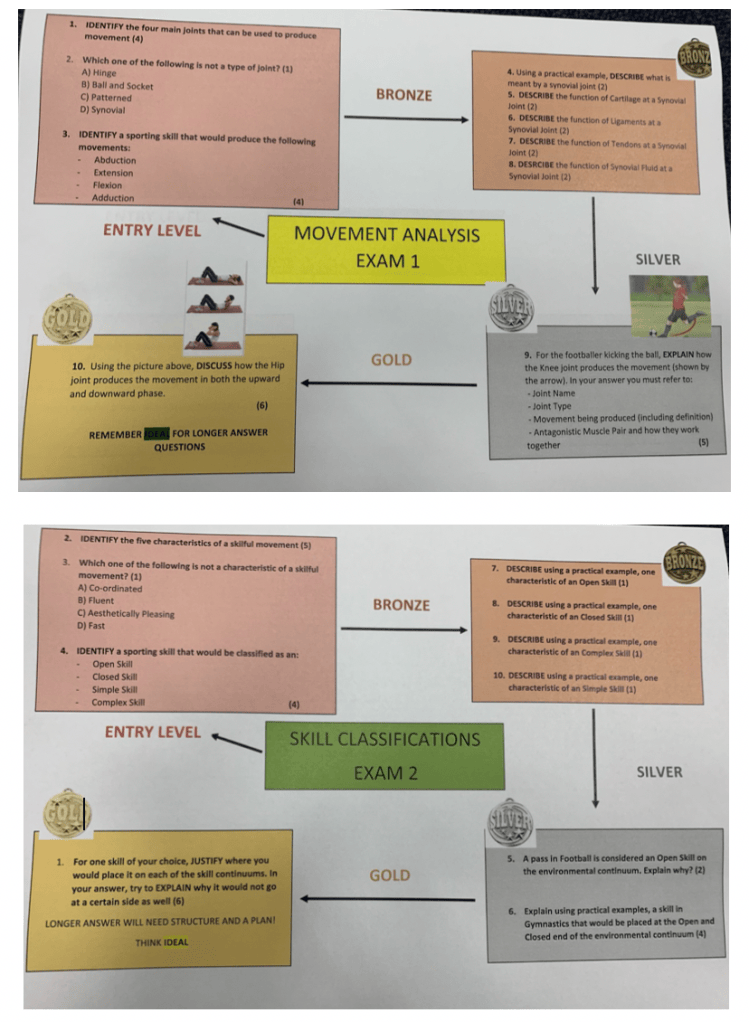
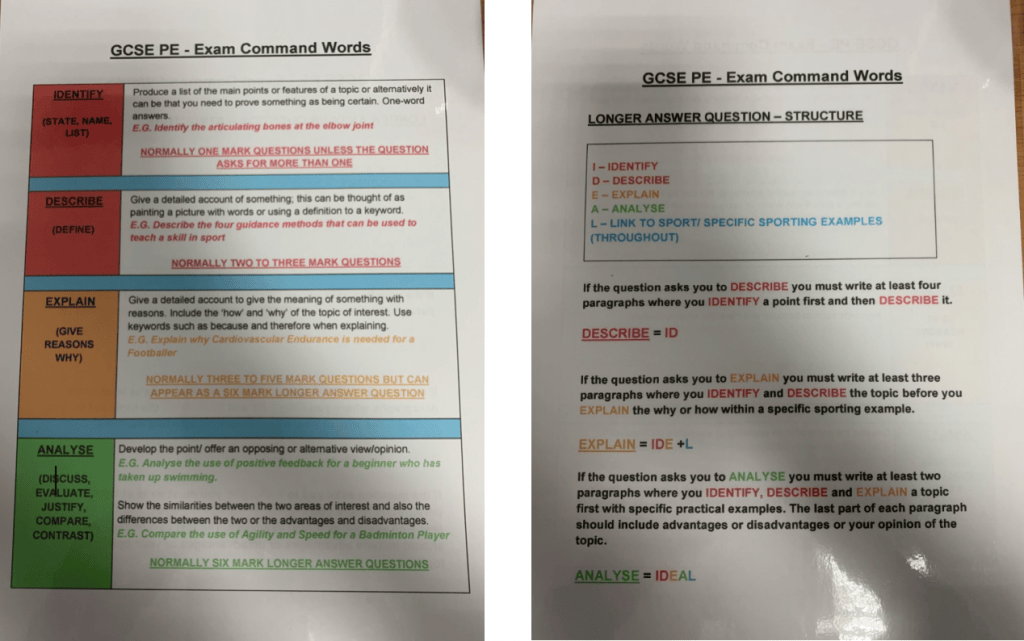
Within the ‘Exam Prep’ lesson students complete a range of past paper exam questions based on the knowledge they have covered in the two lessons that week. The questions are structured using the exam command words so that the depth of answer required for each question gradually gets harder. All of the questions are realistic of what they will get in the real exam and enable students dedicated time to apply their knowledge in a realistic way. All students start at the entry level and then work their way through each of the levels within the allocated time.
In order to create a subject specific learning habit for the students and allow them to practice effectively, I decided that ‘Focused Independent Time’ would be used for students to complete the exam questions. This way they should start to learn that the structure and expectations of the lesson would not change from one week to the next and that over time their exam technique for GCSE PE should improve.
But Miss……when are we doing practical?
Due to the new specification placing a greater emphasis on the theory of PE rather than practical ability, I have also faced another challenge with embedding practice which I knew I would need to address in the ‘Exam Prep’ lesson this year. This challenge centres around boys’ motivation towards theory lessons and ultimately their underachievement in the exams due to a fixed mindset.
Every week, regardless of how many times I explain it, the boys in the group will ask why they are doing theory again and not practical. There seems to be a perception amongst the boys that their practical ability will boost their grade alone without the need to do well in the theory exams.
When doing a practical lesson, the boys will happily practice a skill over and over again without complaining until they are successful, yet when asked to practice their theory knowledge through exam questions they will demonstrate avoidance behaviour and look for the easy way out. This behaviour can be defined as a reluctance to learn or complete work that may challenge them in fear of failing in front of their peers. Instead, boys will only attempt work or challenges that they know they are capable of doing and will result in success; like their practical ability.
With this in mind, I needed to find a way of engaging the boys in my ‘Exam Prep’ lesson so that they were more motivated to practice their learning. I decided that I would introduce a ‘Contender/Coach’ system whereby students were allowed to pick another student in the class that they would compete against and support throughout the year.
In the lesson, students complete as many of the questions as they can in the allocated FIT time. They are provided with the Knowledge Organisers from the two lessons in the week, a GCSE PE textbook, exam command word help sheet and their own books to use if they are unsure of an answer. After 30 minutes, students swap their work with their contender/coach and use the same resources to check their answers and mark them.
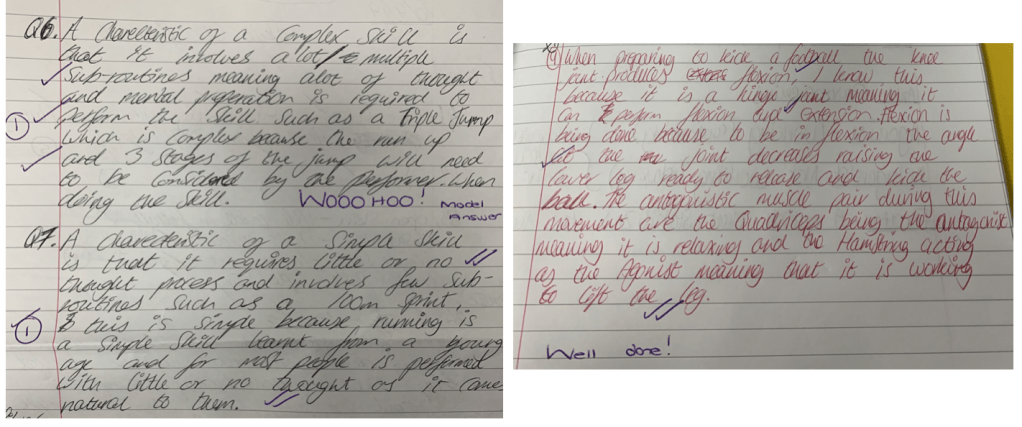
Feedback is given to their contender/coach and then they take their book home to respond to the feedback and make any necessary amendments. They also use the time at home to complete any questions that they did not finish.
Within the lesson, I facilitate during the FIT time and provide help and support when all other avenues have been exhausted. I then mark their books and give them a mark and a grade based on the grade boundaries for each exam which they get in their lesson the following week.
I was expecting to experience some resistance to this, especially with the boys, so I gave myself six weeks to have it embedded and working. However, I was surprised after the first lesson to see all of the boys fully engaged because of the competitive element. It is still very much a work in progress, but I have seen quite a lot of impact for both the students and my teaching in a short period of time. This week I have created a question sheet that links all of the topics we have covered so far together so that students are given an opportunity to continually practice and revisit their knowledge.
Impact on Boys’ Motivation and Progress
- All students are engaged and wanting to practice. This has led to motivation improving dramatically
- Behaviour management is good as students are in a regular routine and know what is expected of them
- Students are happy to make mistakes as they know they are practicing
- Students are engaging with feedback, so they can improve their answers
- Knowledge of exam technique and exam command words is improving as students know and can demonstrate the depth required for each question
- Students are repeating the same content through different exam questions, so retention and knowledge organiser test scores are improving
- Students are enjoying the experience of success whereby it motivates them to try harder in the next lesson
- Independence is improving as they will use the tools and resources provided before asking me
- A growth mind-set is developing where students are not giving up
- Literacy is improving as students are using subject specific terminology
- Knowledge organiser are an integral part of the exam prep lesson whereby students are learning how to use them to practice and revise
- All students are producing work that is on or above their target grade and they are all making progress
Impact on my Teaching
- Marking is quicker and it is easier for me to spot misconceptions and address them instantly in the next lesson
- Tracking grades after each set of questions allows me to see where students are understanding the content and where topics need to be revisited
- Intervention is personalised so that students can practice the topics they need to work on


